
Breathing exercises for stress involve focused, intentional control of your breath to trigger a relaxation response. Simple techniques like deep belly breathing, box breathing, and alternate nostril breathing can help calm the nervous system, reduce anxiety, and improve overall well-being.
Understanding Stress and Your Breath
Stress is your body’s natural reaction to pressure. It’s a survival instinct. When you feel threatened, your body prepares to fight or flee.
This is called the “fight-or-flight” response. Your heart beats faster. Your muscles tense up.
Your breathing becomes quick and shallow.
This response is helpful in dangerous situations. But in modern life, we often face chronic stress. This isn’t from a tiger.
It’s from work deadlines. It’s from traffic jams. It’s from daily worries.
This constant “on” switch can harm your health. It can lead to feeling tired. It can make you feel on edge.
Your breath is deeply connected to this response. When you’re stressed, your breathing changes. It gets shallow.
It happens in your chest. This signals your brain that there’s danger. But you can use your breath to signal the opposite.
You can tell your brain it’s safe. You can activate the “rest-and-digest” response.
This is your body’s natural calming mode. It slows your heart rate. It lowers your blood pressure.
It helps you relax. Learning to breathe deeply and slowly is a key to managing stress. It’s a skill that gets better with practice.
How Stress Affects Your Body
Quick Scan: Stress Reactions
- Heart beats faster
- Muscles get tight
- Breathing becomes shallow
- Mind races
- Feeling agitated
These are all normal stress signs. They happen to keep you safe. But when they don’t stop, it’s hard to cope.
The Power of Deep Belly Breathing
Deep belly breathing is also known as diaphragmatic breathing. It’s one of the simplest and most effective ways to calm down. Most people, when stressed, breathe from their chest.
Their shoulders might even rise. This is shallow breathing. It doesn’t use the full capacity of your lungs.
Your diaphragm is a large, dome-shaped muscle. It sits at the base of your lungs. When you breathe deeply, this muscle moves down.
This pulls air into the bottom of your lungs. Your belly will expand slightly. This is a sign you are breathing correctly.
Why is this so good for stress? Deep belly breaths send a message to your brain. They tell your brain to relax.
This helps turn off the fight-or-flight response. It slows your heart rate. It lowers your blood pressure.
It can even help with digestion.
I remember a time during a big project deadline. I was so stressed. My chest felt tight.
I couldn’t focus. I stopped for just five minutes. I sat up straight.
I put my hand on my belly. I focused on breathing deep into my belly. I felt a real shift.
The tightness eased. I could think clearer. It was amazing how a simple breath could do that.
How to Practice Deep Belly Breathing
1. Find a comfortable spot. You can sit or lie down.
2. Place one hand on your chest. Place the other hand on your belly, just below your ribs.
3. Breathe in slowly through your nose. Try to push your belly out.
Your hand on your belly should rise. Your hand on your chest should move very little. 4.
Breathe out slowly through your mouth. Your belly should fall. 5.
Repeat this for a few minutes. Focus on the feeling of your breath.
Do this a few times a day. Do it when you feel stressed. Or do it just to relax.
It’s a simple habit that builds resilience.
Benefits of Deep Breathing
Key Wins:
- Calms the Nervous System: Signals safety to the brain.
- Lowers Heart Rate: Helps your body relax.
- Reduces Blood Pressure: A physical sign of less stress.
- Improves Focus: Clears the mind for better thinking.
- Relieves Muscle Tension: Less physical tightness.
Box Breathing: A Simple Structure for Calm
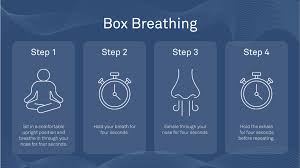
Box breathing is another very helpful technique. It’s also called square breathing. It uses a simple pattern of four counts.
This pattern is easy to remember. It gives your mind something to focus on. This distracts from anxious thoughts.
The method involves four equal parts: inhale, hold, exhale, hold. Each part lasts for the same amount of time. A common count is four seconds for each part.
This makes a “box” shape with your breath. You inhale for four. You hold for four.
You exhale for four. You hold again for four.
This structured approach is great for when your mind is really jumping around. It gives it a clear task. It’s like giving your brain a simple puzzle to solve.
This can interrupt the cycle of worrying. It brings you back to the present moment. It helps ground you.
I once used this before a presentation. My palms were sweating. My stomach felt uneasy.
I found a quiet corner. I closed my eyes. I started the four-second counts.
Inhale through the nose for four. Hold for four. Exhale through the mouth for four.
Hold for four. I did this for a few cycles. It didn’t magically make the nerves vanish.
But it made them manageable. I felt much more in control. I could walk out and give the talk.
How to Practice Box Breathing
1. Find a quiet place. Sit comfortably.
2. Close your eyes gently. 3.
Inhale slowly through your nose for a count of four. Feel your belly fill with air. 4.
Hold your breath gently for a count of four. Do not strain. 5.
Exhale slowly through your mouth for a count of four. Let all the air out. 6.
Hold your breath out gently for a count of four. 7. Repeat this cycle.
Try for a few minutes. You can adjust the count if four feels too long or too short. The key is equal parts.
This exercise is excellent for moments of acute stress. It can be done almost anywhere. You can do it at your desk.
You can do it in a meeting. You can do it in your car (when parked!).
Box Breathing Breakdown
The Four Steps:
- Inhale (4 sec): Through the nose, belly expands.
- Hold (4 sec): Gentle pause, no tension.
- Exhale (4 sec): Through the mouth, release slowly.
- Hold (4 sec): Gentle pause, body rests.
Repeat this cycle to find calm.
Alternate Nostril Breathing (Nadi Shodhana)
This technique comes from yoga. It’s called Nadi Shodhana. It means “channel cleansing.” It’s a bit more involved.
But many find it deeply balancing. It works by using your fingers to block one nostril at a time.
The idea is that your breath flows through two main channels in your body. These are called nadis. One is on the right side.
One is on the left. This exercise helps clear and balance these channels. It’s said to balance the left and right sides of your brain.
This can lead to a feeling of great calm and clarity.
It might sound strange, but trying it can be very revealing. You might notice one nostril feels more open than the other. That’s normal.
This practice helps even things out. It’s especially good for winding down at the end of the day. It can prepare you for sleep.
I was learning this one day. I felt a bit blocked up. My nose was stuffy.
I tried the alternate nostril breathing. I expected it to be difficult. But as I focused on each breath, moving from one side to the other, something shifted.
My breathing felt freer. I felt a sense of quiet spread through me. It was like a gentle internal reset.
I felt more centered.
How to Practice Alternate Nostril Breathing
1. Sit comfortably with a straight spine. You can close your eyes.
2. Bring your right hand up. Use your thumb to gently close your right nostril.
Use your ring finger to gently close your left nostril. You can use your index and middle fingers folded down. 3.
Close your right nostril with your thumb. Exhale slowly through your left nostril. 4.
Inhale slowly through your left nostril. 5. Close your left nostril with your ring finger.
Release your thumb from your right nostril. Exhale slowly through your right nostril. 6.
Inhale slowly through your right nostril. 7. Close your right nostril with your thumb again.
Exhale slowly through your left nostril. 8. This completes one round.
Continue for several rounds. Aim for even breaths. Feel the breath moving through each side.
This is a practice that builds over time. Don’t worry if it feels awkward at first. The focus is on slow, controlled breathing and balance.
It’s a beautiful way to find inner peace.
Alternate Nostril Breathing Flow
Cycle Example:
- Close Right, Exhale Left
- Inhale Left
- Close Left, Exhale Right
- Inhale Right
- Close Right, Exhale Left (completes 1 round)
Focus on smooth, equal breaths.
4-7-8 Breathing: A Sleep and Relaxation Aid
This technique, popularized by Dr. Andrew Weil, is often called the “relaxing breath.” It’s particularly good for calming anxiety and promoting sleep. It uses a specific ratio of inhales, holds, and exhales.
The numbers are 4, 7, and 8.
The key here is the longer exhale. A longer exhale is very effective at activating the parasympathetic nervous system. This is the system that calms you down.
It’s the opposite of the fight-or-flight system. The “hold” phase also gives your body a moment of stillness.
When you are feeling very anxious, your breath often becomes fast and shallow. You might feel like you can’t get enough air. This technique encourages a deep, slow breath.
It can help you feel more in control of your breathing. It can help you feel more grounded.
I’ve used the 4-7-8 method when I’ve had trouble falling asleep. My mind would be buzzing with thoughts. I’d lie there for what felt like hours.
I started practicing the breath. Inhale for 4. Hold for 7.
Exhale for 8. I focused on the long exhale. It felt very soothing.
Within about ten minutes, I felt a wave of relaxation. My body felt heavier in the bed. I drifted off to sleep much more easily.
It’s now a go-to for me.
How to Practice 4-7-8 Breathing
1. Sit or lie down comfortably. 2.
Place the tip of your tongue against the ridge of tissue just behind your upper front teeth. Keep it there throughout the entire exercise. 3.
Exhale completely through your mouth, making a “whoosh” sound. 4. Close your mouth.
Inhale quietly through your nose to a mental count of four. 5. Hold your breath for a count of seven.
6. Exhale completely through your mouth, making the “whoosh” sound, to a count of eight. 7.
This is one breath. Repeat the cycle three more times. For a total of four breaths.
8. You can practice this twice a day. It’s especially helpful before sleep.
Remember, the exhale is the most important part. Make it long and slow. The numbers are a guide.
If 4-7-8 is too difficult, you can adjust them. The ratio is more important than the exact numbers. For example, you could try 2-3-4.
The 4-7-8 Ratio
Breath Sequence:
- Inhale: Count of 4
- Hold: Count of 7
- Exhale: Count of 8 (with “whoosh” sound)
This ratio helps signal deep relaxation.
The Ujjayi Breath: Ocean Sound for Focus
Ujjayi breath, also called ocean breath or victorious breath, is common in yoga. It involves a slight constriction at the back of your throat. This creates a soft, audible sound as you breathe.
It’s like a gentle ocean wave sound.
This sound is actually quite calming. It’s a focal point. When your mind is racing, focusing on the sound of your breath can anchor you.
It’s like a mantra for your lungs. The slight constriction also slows down your exhale. This further encourages relaxation.
It’s a beautiful breath to practice during meditation or yoga. But you can use it anytime you need to find focus and calm. It’s a way to bring awareness to your breath even when you’re busy.
It helps you stay present.
I was in a really noisy coffee shop. I needed to finish some work. The chatter was overwhelming.
I closed my eyes for a moment. I tried the Ujjayi breath. I made that soft ocean sound.
It created a little bubble of calm around me. The external noise faded a bit. I could hear my own breath.
This helped me tune back into my task. It was a small act of self-care in a chaotic environment.
How to Practice Ujjayi Breath
1. Sit comfortably. Close your mouth.
2. Breathe in through your nose. As you exhale through your nose, gently constrict the back of your throat.
This is similar to what you might do to fog up a mirror. 3. You should hear a soft, whispering sound.
This is the Ujjayi breath. 4. Practice this on both your inhales and exhales.
Keep the sound soft and steady. 5. Maintain this gentle constriction.
Focus on the sound and sensation of the breath.
It might take a little practice to get the sound right. Don’t worry about making it loud. The goal is a gentle, internal sound that helps you focus.
It’s a wonderful way to bring a sense of peace into your day.
Ujjayi Breath Elements
Key Components:
- Closed Mouth: Breath through the nose.
- Throat Constriction: Gentle closure at the back of the throat.
- Audible Sound: Creates a soft “ocean wave” sound.
- Focus Point: The sound helps anchor the mind.
Diaphragmatic Breathing vs. Chest Breathing
It’s worth really highlighting the difference between how we often breathe when stressed and how we can breathe. This distinction is fundamental to stress management.
Chest Breathing:
- Shallow breaths
- Uses upper lungs
- Shoulders may rise
- Associated with stress, anxiety, panic
- Can lead to feeling out of breath
- Signals “danger” to the brain
Diaphragmatic (Belly) Breathing:
- Deep breaths
- Uses the full lung capacity
- Belly expands with inhale
- Associated with relaxation, calm
- Signals “safety” to the brain
- Helps lower heart rate and blood pressure
The transition from chest to diaphragmatic breathing is a physical switch. It can physically change your internal state. It’s like flipping a switch from “alert” to “at ease.”
Chest vs. Belly Breathing: A Quick Look
Contrast Matrix:
| Chest Breathing | Belly Breathing |
| Shallow | Deep |
| Fast | Slow |
| Shoulders rise | Belly expands |
| Stress signal | Relaxation signal |
Real-World Scenarios: When to Use These Techniques
These breathing exercises aren’t just theory. They are practical tools for everyday life. Think about situations where stress hits hard.
Scenario 1: The Unexpected Bill
You open your mail. There’s a bill that’s much higher than you expected. Your heart skips a beat.
You feel a knot in your stomach. Your breath hitches. This is a moment to pause.
Sit down if you can. Take three deep belly breaths. Inhale through your nose, exhale through your mouth.
Focus on the rise and fall of your belly. This gives you a moment to gather yourself before reacting.
Scenario 2: Pre-Meeting Jitters
You have an important meeting coming up. You’re worried about what will be said. Or you have to speak.
Your mind races. You feel tense. Before you go in, find a quiet spot.
Do a round of box breathing. Inhale for four, hold for four, exhale for four, hold for four. This structured breath can help clear your head and calm your nerves.
Scenario 3: Trouble Sleeping
You’re lying in bed. Your thoughts are spinning. You’re replaying the day or worrying about tomorrow.
Sleep feels miles away. Try the 4-7-8 breathing technique. Focus on that long, slow exhale.
Let the “whoosh” sound be your guide. Allow your body to sink deeper into the mattress. This can help quiet your mind and prepare you for rest.
Scenario 4: Feeling Overwhelmed at Work
Your inbox is full. Your phone is ringing. Tasks are piling up.
You feel like you’re drowning. Take a micro-break. Step away from your desk.
Even 60 seconds can help. Practice alternate nostril breathing. This can help you feel more balanced and centered.
It allows you to return to your tasks with a clearer mind.
These moments happen to everyone. The key is to have tools ready. Breathing exercises are always available.
Breathing for Different Moments
Quick Guide:
- Sudden Stress: Deep Belly Breathing
- Racing Thoughts: Box Breathing
- Anxiety/Sleep Issues: 4-7-8 Breathing
- Need for Focus: Ujjayi Breath / Alternate Nostril Breathing
What This Means for You
Understanding these breathing techniques is one thing. Using them is another. It means shifting from a reactive state to a proactive one.
It means recognizing that you have control over your body’s stress response.
When it’s normal: It’s completely normal to feel stressed. Life is unpredictable. Your body is designed to react.
These feelings are not a sign of weakness. They are a sign that you are human.
When to worry: If stress feels constant. If it interferes with your daily life. If you struggle to sleep, eat, or function.
If you feel hopeless. If you are using unhealthy coping mechanisms. In these cases, it’s important to seek professional help.
Talk to a doctor or a mental health professional.
Simple checks: Are you noticing physical signs of stress? Tight shoulders? Headaches?
Upset stomach? Are you feeling more irritable? Are you having trouble concentrating?
These are all signals. They are your body’s way of telling you to pay attention. Breathing exercises can be a first step in managing these signals.
The exercises are not a cure-all. But they are a powerful support system. They build a foundation of calm.
They equip you to handle challenges better. Consistent practice is key. Even a few minutes each day can build up your resilience.
Quick Tips for Starting Your Practice
Starting a new habit can feel daunting. Here are some simple ways to begin incorporating breathing exercises into your life.
- Start Small: Don’t try to do an hour of breathing exercises at once. Begin with 1-2 minutes. Gradually increase the time.
- Pick One Technique: Focus on mastering one technique first. Deep belly breathing is a great starting point.
- Set Reminders: Use your phone to set a reminder. For example, “Take 5 deep breaths” at 10 AM and 3 PM.
- Link to Existing Habits: Practice after brushing your teeth. Or before you eat lunch. Or right before you go to bed.
- Be Patient: It takes time. Your mind will wander. That’s okay. Gently bring your focus back to your breath.
- Don’t Judge: There’s no “right” or “wrong” way to breathe. Just focus on doing it with awareness.
- Notice the Effects: Pay attention to how you feel after practicing. This positive feedback can motivate you.
These tips are meant to make it easy to start. The goal is to build a sustainable practice. One that supports your well-being long-term.
Frequently Asked Questions About Breathing Exercises
Are breathing exercises safe for everyone?
Yes, for most people, breathing exercises are very safe. They are a natural bodily function. However, if you have certain medical conditions, like severe lung or heart issues, it’s always best to talk to your doctor before starting any new practice.
They can give you personalized advice.
How quickly will I see results from breathing exercises?
You might feel some immediate effects, like a sense of calm, after just a few minutes. For deeper, lasting changes, regular practice is key. Think of it like exercise for your body.
You build strength and stamina over time. Consistency is more important than intensity.
Can I do breathing exercises while I’m driving?
It’s safest to do breathing exercises when you are parked. While some simple deep breathing might be okay, more complex techniques like alternate nostril breathing require attention. Your focus should always be on the road when driving.
Save these practices for when you’re stopped.
What if my mind wanders a lot when I try to breathe?
That’s perfectly normal! Your mind is designed to think. When you notice your mind wandering, don’t get frustrated.
Just gently acknowledge the thought. Then, guide your attention back to your breath. This act of noticing and returning is a core part of the practice.
How long should I practice each day?
Start with just 1-5 minutes a day. Even this short amount can be beneficial. As you get more comfortable, you can gradually increase the duration.
Many people find it helpful to practice for 10-15 minutes, perhaps once or twice a day, for maximum benefit.
Can breathing exercises replace medication for anxiety?
Breathing exercises are a powerful tool for managing stress and anxiety symptoms. They can greatly improve your well-being. However, they are not typically a replacement for prescribed medication for severe anxiety disorders.
If you are on medication, talk to your doctor about how breathing exercises can complement your treatment plan.
Conclusion: Breathe Your Way to Calm
Your breath is a constant, free resource. Learning to use it intentionally is a profound skill. These breathing exercises offer simple paths to reduce stress.
They help calm your mind and body. Start with one. Practice it often.
You’ll soon discover the peaceful power held within your own breath.
